Thursday, 31 October 2019

Sena in touch with BJP, Congress, NCP, but won't ditch allies: Uddhav

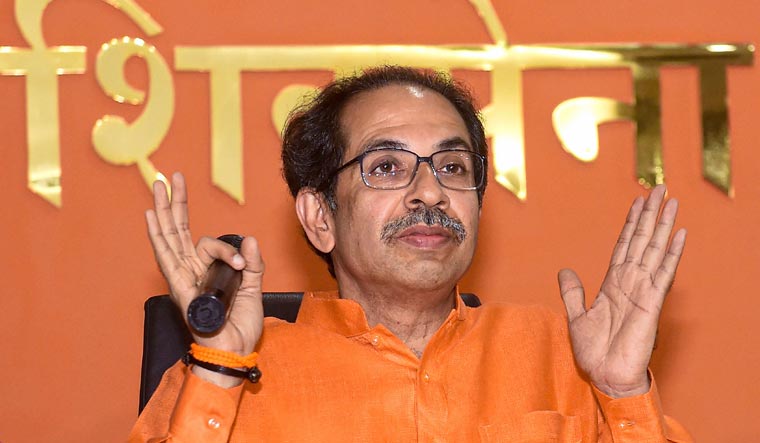
Shiv Sena chief Uddhav Thackeray speaks during a press conference at Sen Bhavan in Mumbai | PTI(File) Shiv Sena chief Uddhav Thackeray speaks during a press conference at Sena Bhavan in Mumbai | PTI
Shiv Sena chief Uddhav Thackeray on Thursday sounded a note of defiance soon after the party announced the election of veteran Eknath Shinde as legislature party chief.
Uddhav told Shiv Sena MLAs in Mumbai that the Shiv Sena remained firm on its demand that it wanted the chief minister's post for the party, which its ally, the BJP, has publicly not agreed to yet. Uddhav declared that the Shiv Sena "would not ditch its alliance partners", but demanded that the BJP first "agree to what you committed to".
Uddhav declared that the Shiv Sena was in touch with the BJP, Congress and NCP after the election results, sending an ominous message to the larger saffron party. He also claimed the Shiv Sena was in “no hurry” to push for formation of a government in Maharastra. A Shiv Sena delegation is slated to meet Maharashtra Governor Bhagat Singh Koshyari at 6.30pm on Thursday; the meeting had initially been announced for 3.30pm, but was postponed.
Since the Assembly election results were announced a week ago, the Shiv Sena and Uddhav have demanded that the BJP fulfil its "pledge" of implementing their agreement of "50:50" sharing of portfolios and the chief minister's post.
Earlier this week, the Shiv Sena had circulated a video clip of a press conference with Chief Minister Devendra Fadnavis, which was held in February.
"We have decided equal sharing of posts and responsibilities once we come to power again," Fadnavis is quoted as saying in Marathi at the presser to announce the Shiv Sena-BJP tie-up for the Lok Sabha elections. However Fadnavis denied that BJP chief Amit Shah had promised the Shiv Sena the sharing of the chief minister's post for a 2.5 year period.
Read more ...

Indians among most sleep-deprived, says Fitbit study

sleep-computer-laptop-work-sleep-deprived-shut
Indians are the second-most sleep deprived after Japanese people, getting an average night sleep of 7 hours 1 minute, says a report by fitness solutions firm Fitbit.
Indians get 77 minutes of REM sleep on average, which is the lowest in the world just like Japanese, who get the same amount of average REM sleep. 
Rapid eye movement (REM) sleep is a crucial aspect for emotion regulation, memory, and the peak stage of protein synthesis at the cellular level that ensures that multiple processes in the body work properly, according to the report.
India has emerged as the least-active country among 18 countries including the US, the UK, Japan and Singapore, walking an average of 6,533 steps daily, according to the report.
Based on aggregated and anonymised user data insights from 18 countries, the Fitbit report found that "Indians are the least active and log in only 6,533 steps daily, the least amongst all 18 countries which is 3,600 steps lesser than the average of the most active country—Hong Kong".
Average active minutes (32) also fare the lowest in the grid, it added.
Indians also get the least amount of nightly sleep on average (after Japan) at 7 hours 1 minute, which is 48 minutes lesser than the average nightly sleep of users in the UK and 32 minutes lesser than average nightly sleep of Americans, the report said.
Ireland got the highest amount of average night sleep at 7 hours and 57 minutes.
Interestingly, the report found Indian users in the age group of 75-90 got the lowest sleep (6 hours 35 minutes on average) compared to other age groups, even though users in the age group of 18-25 years went to bed more than an hour later (12:33 AM) than users in 75-90 age group (11:22 PM). 
(With input from PTI)
Read more ...

Tiring to constantly prove yourself: Yami Gautam

72-Yami-GautamYami Gautam | AP
There is a duality in the way male and female stars are treated in the industry which expects women to constantly prove their worth, says Yami Gautam.
The actor, who made her debut with Shoojit Sircar's Vicky Donor and most recently featured in the blockbuster Uri-The Surgical Strike, said despite her performance being praised, she could not escape being stereotyped, something that did not happen to her male co-stars. "My first film had a performance-oriented role and people did notice that. But (there's) stereotype because it was not a conventional role from an actress' point of view. That's where an actress and an actor differ.
"'Oh, she has looked a certain way' so only certain type of roles were coming my way. I realised that it's very important to keep working on yourself and reinventing yourself in some way or the other to get diverse roles," Yami said in a group interview here.
The 30-year-old star said she found it absurd that she had to project her "strong girl" role in Uri. "Kaabil had a very sensitive performance, even in 'Uri', yes, it was about Army and about that entire operation but... I feel very weird when you have to project that I play a strong girl. Why? It doesn't happen with any actor, they don't have to say 'I am playing a strong guy'.
"You really have to work hard and people like me have to put in a lot of effort to keep proving themselves which can be tiring. But that's okay, that's the job." Yami said despite not having a "certain surname" or "a Godfather" in the industry, she has learnt to navigate her way.
"I don't have a social network here, where you can lean on someone when it comes to your professional circle. There's nothing wrong in it but I'm saying it as a matter of fact. I am what I am, there's a certain price to it but I'm fine." Yami, who stars opposite Ayushmann Khurrana, credited director Amar Kaushik and producer Dinesh Vijan, for recognising her talent and casting her in Bala.
"I am glad that people like Dinesh, Amar, had faith in my talent and performance. When you watch the film, you'll realise that my name wouldn't instantly come to your head seeing what you'll see... It's only a matter of time, your one Friday takes you to another, where people push you in a certain role which is absolutely new. It can take a while but it'll happen. I'm in no hurry," she added.
The film is scheduled to release on November 7.
Read more ...

Monday, 28 October 2019

'Housefull 4' rakes in Rs 53 crore in first three days

housefull-4
Akshay Kumar's Housefull 4 has earned Rs 53 crore in the first three days of its release, the makers said on Monday.
The Farhad Samji-directed film opened on October 25 to mixed reviews. On the first day, the film raked in Rs 19.09 crore. Producer Sajid Nadiadwala, however, believes the film will perform better in the coming days as the festive season has concluded.
"The first three days of our film release were like paid previews. People have come despite the festive season & enjoyed the film. I think we had the best paid previews with a total collection of 53cr and our actual weekend starts today," Nadiadwala said in a statement.
The movie also features Riteish Deshmukh, Bobby Deol, Kriti Sanon, Pooja Hegde and Kriti Kharbanda.
Read more ...

Man arrested for drunken-driving discovers his stomach 'brews beer'

beer_month-alcohol
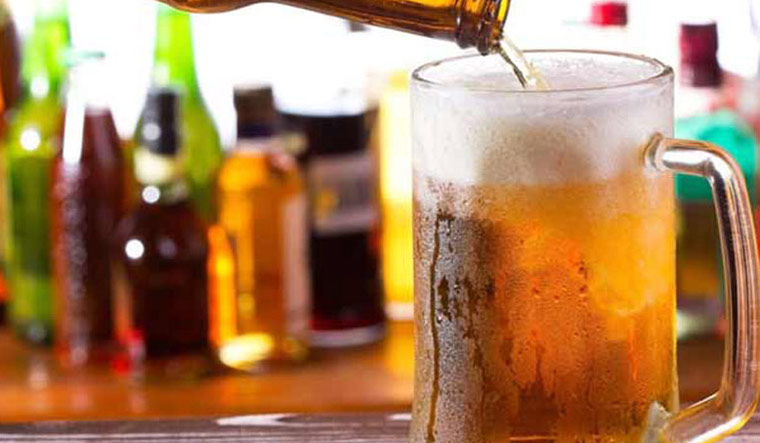
A 46-year-old, who was pulled over for drunken-driving couldn't make his case to police and doctors when he swore that he hadn’t had alcohol before he was arrested on suspicion of drunken driving.
His blood-alcohol level was 0.2, more than twice the legal limit for operating a car. After refusing a breathalyzer test, was hospitalized and later released after researchers discovered an unusual truth— the man was suffering from a rarely diagnosed condition, 'auto-brewery system'. Fungi in the 46-year-old man’s digestive system were turning carbohydrates into alcohol.
The syndrome that causes fermenting fungi or bacteria in the gut to produce ethanol, which can lead to the patient showing signs of drunkenness. Also known as gut fermentation syndrome, it is more common in patients with diabetes, obesity or Crohn’s disease.
“A person is intoxicated from this fermenting yeast, and it’s a horrible illness,” said Barbara Cordell, a researcher of the auto-brewery syndrome and the author of 'My Gut Makes Alcohol.'
The condition made news in 2014 when the driver of a truck that spilt 11,000 salmon onto a highway claimed to have the auto-brewery syndrome.
People with auto-brewery syndrome tend to smell like alcohol or feel too tired to work or pursue other activities. Patients sometimes tend to skip meals to stay sober.
Some causes of the syndrome include environmental toxins, preservatives and other drugs that could disrupt the body’s normal balance of bacteria.
Experts recommend those suffering from the condition to seek treatment for alcohol poisoning if the person feels severely intoxicated.
Read more ...

Smile, even a fake one, can trick brain into happiness

Wild hair, short hair, long hair... do careRepresentational Image | Pixabay
Feeling low? Try smiling. Wearing a smile could trick your brain into happiness.
Even a fake smile could make you feel better. Take for instance, a non-Duchenne smile—the smile you wear when someone is about to take a photo of you. In a non-Duchenne smile, someone says , 'cheese,' and you simply raise the corners of your mouth. “It has been shown in many studies that even if you are not happy being in a certain situation, and you just smile, slowly you will start to feel the same situation to be much more okay to be in,’’ says Dr Sagar Mundada, a consultant psychiatrist at Healthspring, Mumbai.
How does a facial expression trigger a corresponding emotion? “Our facial expressions send muscular signals to the brain, making us feel emotions corresponding to the expressions,’’ explains Mundada.
Facial feedback hypothesis states that our facial expressions affect our emotions. It could hold true not just for happiness, but other emotions as well. It is also a good way to keep your emotions in check when you feel overwhelmed by negative emotions such as fear or anger.
A classic experiment by Paul Ekman in 1983 established this hypothesis, says Dr Rekha Ahuja, assistant professor and head, department of psychology and counseling, St Joseph’s Evening College, Bengaluru. “A group of professionally trained actors was asked to make facial expressions such as raising their eyebrow and stretching their lips wide towards the ears. This made their heart rate increase and body temperature decline, similar to the reactions seen during the emotional experience of fear,’’ explains Rekha. “When we smile, we are more likely to experience the emotion of happiness, even though our environment doesn't provide any clue to make us feel happy. Similarly, facial expressions for different emotions evoke physiological changes congruent to that emotion. Therefore facial expressions not only accompany but also produce emotional experiences,’’ she adds.
Facial feedback hypothesis could help us regulate our emotions when we are overwhelmed by anger or fear. It helps us experience positive emotions more and avoid negativity. “So avoid frowning, if you don’t want to feel unhappy. If you don’t want to feel angry, stop clenching your teeth,’’ says Mundada.
Dr Shyam Bhat agrees with the facial feedback hypothesis. “The mind-body relationship is certainly bilateral—each influences the other. And just as moods alter our body as well as facial expressions, alteration of facial expression can influence mood.’’ That said, he adds the facial feedback hypothesis does not work always. For instance, smiling may not make someone having a major depressive disorder feel better immediately. “The effects of facial feedback hypothesis are mild and will not be sustained in people with more serious affective disorders,’’ argues Bhat.
“Moreover, although facial expressions are the most obvious physical manifestation of depression, it affects the entire body, and therefore changing only facial muscle function will not achieve long-term results. A more holistic approach is to use bodywork and yoga,’’ he says.
Read more ...

Soft drinks consumption common factor between obesity and tooth wear: Study

soda-cola-drinks-sweetened-drink
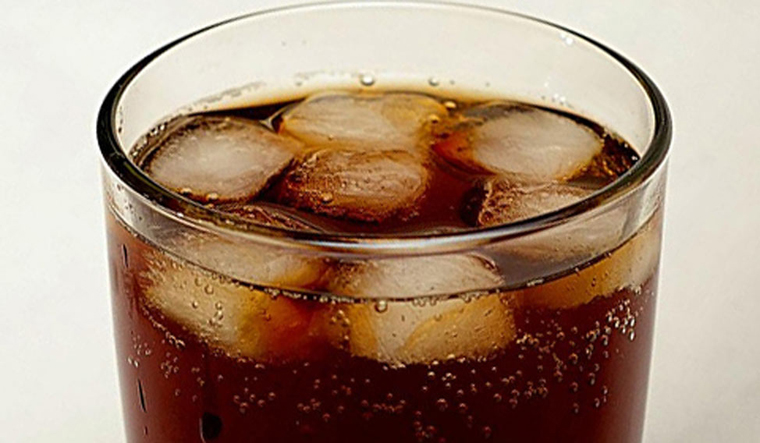
The consumption of sugar-sweetened acidic drinks -- such as soft drinks -- is the common factor connecting obesity and tooth wear among adults, according to a study which suggests that dentists should be concerned about the calories their patients get from carbonated beverages.
The researchers, including those from King's College London, found that being overweight, or obese, was strongly associated with having worn out teeth.
The findings of the study, published in the journal Clinical Oral Investigation, suggests that the increased consumption of sugary soft drinks by obese patients may be the leading cause of the erosion of the tooth enamel, and dentine -- the hard bony structure forming the bulk of a tooth.
The researchers analysed a sample of survey participants of 3,541 patients in the United States based on data from the National Health and Nutrition Examination Survey 2003-2004.
For the study, the researchers took into account patient BMI, their intake of sugar sweetened acidic drinks, and their levels of tooth wear.
"It is the acidic nature of some drinks such as carbonated drinks and acidic fruit juices that leads to tooth wear," said lead author Saoirse O'Toole from King's College London.
According to the researchers, tooth wear ranked as the third most important dental condition -- after cavities and gum disease -- and its leading cause is the consumption of acidic foods and drinks.
"This is an important message for obese patients who are consuming calories through acidic sugar sweetened drinks. These drinks may be doing damage to their body and their teeth," O'Toole said.
The researchers said that changing consumption habits can help patients prevent tooth wear, or at least stop it before it gets worse.
"There is also an important message for dentists. We should be asking our patients who are obese and have tooth wear what calories they are drinking as this may be having an effect on their full bodies - not just their teeth," O'Toole said.
Read more ...